
 USA WAREHOUS
 EUROPE WAREHOUSE
No products in the cart.
Wolverine 5+5mg | BPC-157+TB-500 – Nitro Probolic
$179.00
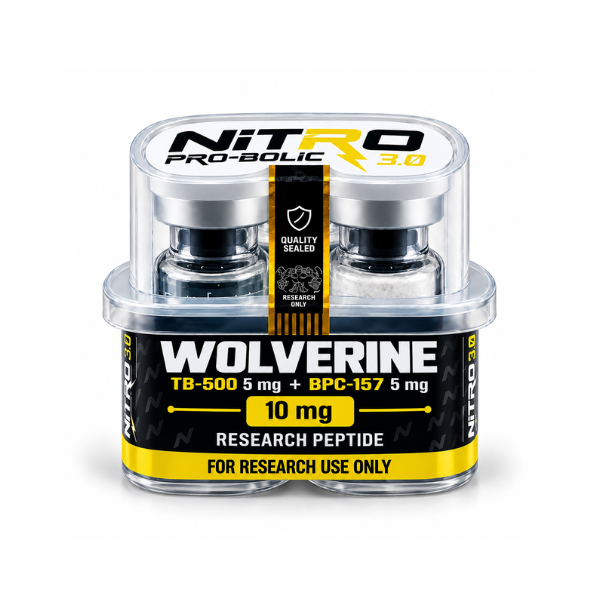
Product Name: Wolverine 5+5 mg — BPC-157 + TB-500
Brand: Nitro Pro Bolic (According to Product Title and Roidsdeal Long Description)
Manufacturer: Not Independently Verified; Roidsdeal Short Description Lists Nitro Labs
Active Ingredients: BPC-157 + TB-500 (Intended Formulation; Verification Required)
Declared Strength: BPC-157 5 mg + TB-500 5 mg
Total Peptide Content: 10 mg per Vial
Product Form: Research Peptide Blend — Physical Form Not Confirmed
Packaging: Vial Configuration Requires Verification. Roidsdeal Short Description Lists 1 × 10 mg Vial + 1 × 2 mL Bacteriostatic Water Vial, but Identifies Different Active Ingredients.
Classification: Experimental Peptide Combination / Research Peptides
Research Areas: Preclinical Tissue-Repair Mechanisms, Cellular Signaling, Connective Tissue Biology, Cell Migration, Cytoskeletal Organization, and Inflammatory Signaling
Active Half-Life: Not Reliably Established for the Combination
Aromatization: Not Applicable — Neither Compound Is an Anabolic-Androgenic Steroid
Clinical Evidence: Predominantly Preclinical; Human Therapeutic Safety and Efficacy of This Combination Have Not Been Established
Regulatory Status: Neither BPC-157 nor TB-500 Is Established as an FDA-Approved Human Therapeutic Ingredient
Administration Status: Research Use Only — Not Approved for Human Therapeutic Administration
Product Verification: Critical ingredient conflict detected. Roidsdeal’s Short Description identifies Ipamoreline 5 mg + CJC-1295 5 mg, while the title, Roidsdeal Long Description, and both Finest Gears descriptions identify BPC-157 5 mg + TB-500 5 mg. Ingredient identity, manufacturer, packaging, and batch-specific testing must be verified before publication.
Wolverine 5+5 mg – BPC-157 + TB-500 Research Peptide Blend | Nitro Pro Bolic
1. Product Overview
Wolverine 5+5 mg is presented as an experimental research peptide combination containing two compounds: BPC-157 and TB-500.
According to the supplied Roidsdeal product title, Roidsdeal long description, and both Finest Gears descriptions, the intended formulation contains:
- BPC-157 — 5 mg
- TB-500 — 5 mg
- Total declared peptide content — 10 mg
The product is associated with the Nitro Pro Bolic brand in the Roidsdeal title and long description.
Both peptides have attracted scientific interest because of research involving cellular signaling, connective tissue biology, cell migration, and processes associated with tissue repair.
BPC-157 has primarily been investigated in experimental and preclinical models involving gastrointestinal tissues, muscles, tendons, and other biological systems.
TB-500 is associated with research involving thymosin beta-4-related peptide sequences and cellular mechanisms, including actin regulation and cell migration.
However, the biological properties of full-length thymosin beta-4 should not automatically be attributed to a TB-500 product without verifying its exact molecular identity.
The Wolverine combination itself has not been established as a clinically effective treatment for injuries, inflammation, or tissue recovery.
An important product-data discrepancy requires attention.
Roidsdeal’s short description identifies an entirely different peptide combination: Ipamoreline 5 mg and CJC-1295 5 mg.
That description also lists Nitro Labs as the manufacturer and includes a 2 mL vial of bacteriostatic water.
These details conflict with the intended Wolverine formulation and cannot be accepted without further verification.
The following description therefore uses BPC-157 5 mg + TB-500 5 mg as the intended formulation, while treating ingredient identity, packaging, and manufacturer information as unverified.
2. What Is Wolverine?
Wolverine is a commercial product name used for a research peptide combination containing BPC-157 and TB-500.
The term Wolverine is a product designation rather than a recognized pharmacological classification.
The two compounds are investigated separately in different areas of experimental biological research.
BPC-157
BPC-157 is an experimental synthetic peptide consisting of 15 amino acids.
It has been investigated in preclinical research involving gastrointestinal protection, tissue-associated signaling, and responses to experimental injuries.
Research has explored its relationship with cellular processes involving blood vessels, inflammatory signaling, and connective tissue.
However, the available evidence does not establish that BPC-157 is a safe or effective treatment for human injuries.
TB-500
TB-500 is a commercial designation associated with thymosin beta-4-related peptide research.
The exact molecular identity of products sold as TB-500 can vary or may not be adequately documented.
Thymosin beta-4 is a naturally occurring protein involved in actin-related cellular processes.
Research involving thymosin beta-4 and related peptide sequences has explored cellular migration, cytoskeletal organization, and tissue-associated biological responses.
However, findings involving full-length thymosin beta-4 cannot automatically be applied to every TB-500 preparation.
Combined Formulation
The intended Wolverine product combines 5 mg of BPC-157 with 5 mg of TB-500.
The scientific rationale for investigating this combination involves the different cellular pathways associated with each compound.
Nevertheless, there is insufficient reliable human clinical evidence to establish that combining these peptides produces additional or synergistic therapeutic effects.
3. How Does Wolverine Work?
Wolverine is described as a combination of two experimental peptides with different proposed biological activities.
The mechanisms discussed below are based primarily on research involving the individual compounds or related peptide systems.
They do not establish the pharmacological performance of this commercial blend.
BPC-157 and Cellular Signaling
Preclinical studies have investigated BPC-157 in relation to cellular signaling pathways associated with experimental tissue injuries.
Research has explored potential effects involving vascular signaling, inflammatory responses, and cellular processes relevant to connective tissue.
Some experimental investigations have reported changes in biological markers associated with tissue repair.
However, these findings are not sufficient to establish clinical effectiveness in humans.
TB-500 and Actin-Related Processes
TB-500 is associated with thymosin beta-4-related research.
Thymosin beta-4 participates in biological processes involving actin, a structural protein important for cell shape, movement, and cytoskeletal organization.
Experimental research involving thymosin beta-4 and related sequences has examined cell migration and tissue-associated responses.
The precise molecular composition of a TB-500 product must be verified before attributing specific experimental findings to it.
Cell Migration and Tissue Remodeling
Cell migration is an important component of normal biological responses to tissue damage.
Research involving thymosin beta-4-related systems has explored how actin-associated processes may influence cell movement.
BPC-157 research has separately investigated signaling pathways potentially associated with experimental tissue responses.
However, these findings do not demonstrate that the Wolverine combination accelerates recovery in humans.
Combined Peptide Activity
The intended combination contains two peptides associated with different areas of experimental research.
Combining them does not automatically create additive or synergistic biological effects.
The interaction, pharmacokinetics, safety, and biological performance of the combined formulation have not been adequately established through controlled human clinical studies.
4. Medical Uses & Clinical Information
Wolverine is an experimental peptide combination rather than an established medical treatment.
The following areas describe scientific research interests, not approved therapeutic indications.
Muscle Tissue Research
BPC-157 has been investigated in preclinical models involving experimental muscle injuries.
These studies have explored biological responses associated with tissue damage and recovery.
However, findings from animal or laboratory studies do not demonstrate clinical effectiveness in humans.
Tendon and Ligament Research
Experimental studies involving BPC-157 have examined cellular and tissue-associated responses in tendon and ligament injury models.
Such investigations contribute to scientific understanding of connective tissue biology.
They do not establish that BPC-157 or Wolverine can treat tendon or ligament injuries in humans.
Cell Migration Research
Research involving thymosin beta-4 and related peptide sequences has investigated cellular migration and cytoskeletal dynamics.
These processes are relevant to normal tissue maintenance and experimental tissue-repair models.
However, results involving full-length thymosin beta-4 cannot automatically be attributed to commercial TB-500 preparations.
Inflammatory Signaling
BPC-157 has been studied in experimental models involving inflammation-related pathways.
The findings are preliminary and do not establish a clinically meaningful anti-inflammatory effect in humans.
Peptide Combination Research
The BPC-157 and TB-500 combination has attracted interest because both compounds are associated with tissue-related biological research.
However, there is insufficient controlled human clinical evidence to establish the effectiveness, safety, or superiority of the combined formulation.
Clinical Limitations
Neither BPC-157 nor TB-500 is established as an FDA-approved human therapeutic ingredient.
The supplied documentation does not identify completed controlled human clinical trials demonstrating the safety or effectiveness of this Wolverine product.
Therefore, it should not be described as a proven treatment for muscle injuries, tendon damage, ligament injuries, or other medical conditions.
5. Product Specifications & Packaging
| Specification | Details |
|---|---|
| Product Name | Wolverine 5+5 mg |
| Brand Reference | Nitro Pro Bolic |
| Manufacturer | Not Independently Verified |
| Conflicting Manufacturer Reference | Nitro Labs |
| Intended Active Ingredient 1 | BPC-157 |
| Declared BPC-157 Content | 5 mg |
| Intended Active Ingredient 2 | TB-500 |
| Declared TB-500 Content | 5 mg |
| Total Intended Peptide Content | 10 mg |
| Compound Classification | Experimental Peptide Combination |
| Product Category | Research Peptides |
| Physical Form | Not Confirmed |
| Peptide Vial Quantity | 1 Vial Claimed in Conflicting Short Description |
| Bacteriostatic Water | 2 mL Claimed in Conflicting Short Description |
| Final Packaging Configuration | Verification Required |
| Active Half-Life | Not Reliably Established |
| FDA-Approved Human Therapeutic Use | Not Established |
| Human Administration Status | Not Approved |
| Batch-Specific Laboratory Testing | Claimed Available; Not Provided |
| Purity and Sterility | Not Independently Verified |
The intended 5 mg + 5 mg formulation is supported by the product title, Roidsdeal long description, and both Finest Gears descriptions.
However, Roidsdeal’s short description lists Ipamoreline and CJC-1295 instead.
Although both formulations have a total declared peptide content of 10 mg, they contain entirely different substances.
The total milligram amount alone cannot establish product identity.
The packaging also requires verification because the 2 mL bacteriostatic water claim appears in the conflicting short description.
The exact molecular identity of the TB-500 component should be established through manufacturer documentation.
6. Research Use & Scientific Supervision
Wolverine is described as an experimental peptide combination.
Its proposed ingredients are not established as approved medications for human tissue repair or injury recovery.
No validated human dosing regimen, administration schedule, or treatment protocol has been established for this commercial formulation.
The intended 10 mg amount represents the combined declared peptide content, not a recommended single dose.
The supplied sources do not provide reliable product-specific information establishing a validated administration route or reconstitution procedure.
The possible inclusion of bacteriostatic water does not establish that the peptide formulation is sterile or suitable for injection.
Research involving experimental peptide combinations requires verified material identity, appropriate scientific oversight, and compliance with applicable regulations.
Because the supplied descriptions contain conflicting ingredient information, the product should not be used in research requiring verified compound identity until the discrepancy is resolved.
7. Possible Side Effects & Safety Limitations
The human safety profile of the Wolverine combination has not been adequately established.
Reliable controlled clinical data are insufficient to determine the frequency, severity, or long-term consequences of adverse effects associated with this specific formulation.
Important safety uncertainties include:
- Unknown long-term effects of BPC-157 exposure
- Inadequately characterized human safety of TB-500 preparations
- Potential immune or hypersensitivity reactions
- Uncertain effects on vascular and inflammatory signaling
- Unknown interactions between the two peptides
- Potential differences in biological activity between TB-500 preparations
- Risks associated with impurities or incorrect peptide identity
- Possible contamination or sterility failures in unverified products
- Unknown consequences of repeated exposure
Some experimental research has investigated cellular pathways related to blood vessel formation and tissue remodeling.
However, the clinical significance and long-term safety implications of these findings remain uncertain.
The absence of established adverse-event rates should not be interpreted as evidence that the combination is safe.
Furthermore, findings involving individual compounds cannot establish the safety profile of the combined product.
8. Warnings & Precautions
BPC-157 and TB-500 are experimental compounds whose therapeutic safety and efficacy in humans have not been adequately established.
The Wolverine combination should not be represented as an FDA-approved treatment for injury recovery, tissue regeneration, inflammation, or any other medical condition.
Preclinical findings do not guarantee therapeutic benefits in humans.
The safety of this combination during pregnancy, breastfeeding, childhood, or adolescence has not been established.
Potential interactions with medications and underlying medical conditions have not been adequately characterized.
Product identity is particularly important because the supplied Roidsdeal short description identifies different peptides from those listed in the product title and other descriptions.
The exact molecular identity of the TB-500 component should also be verified.
No assumption should be made regarding purity, sterility, or pharmaceutical manufacturing quality without supporting evidence.
Research-use labeling does not establish regulatory compliance or remove applicable legal requirements.
9. Storage & Handling
The supplied sources do not establish verified manufacturer storage temperatures, stability data, or expiration requirements for the Wolverine formulation.
Storage requirements may depend on the exact peptide composition, physical form, excipients, and packaging.
Because the physical presentation has not been confirmed, powder-specific or solution-specific storage instructions should not be assumed.
If the final product includes bacteriostatic water, the accompanying vial should have independently verified labeling, composition, expiration information, and storage instructions.
The supplied descriptions do not establish validated compatibility or stability after combining any peptide material with the accompanying liquid.
No product-specific reconstitution or post-reconstitution storage procedure can be confirmed.
Research materials should remain clearly labeled and protected from unauthorized access.
Products with uncertain ingredient identity, compromised packaging, or unverified storage history should not be assumed suitable for laboratory or human use.
10. Frequently Asked Questions (FAQs)
What is Wolverine 5+5 mg?
Wolverine is presented as an experimental research peptide blend containing 5 mg of BPC-157 and 5 mg of TB-500, for a total declared peptide content of 10 mg.
What is the difference between BPC-157 and TB-500?
BPC-157 has been investigated primarily in preclinical studies involving tissue-associated signaling and experimental injury models. TB-500 is associated with thymosin beta-4-related research involving actin regulation and cell migration. Their exact biological properties and clinical implications differ.
Is Wolverine proven to accelerate muscle or tendon recovery?
No. Available evidence does not establish that this peptide combination safely or effectively accelerates human muscle, tendon, or ligament recovery.
Does the package include bacteriostatic water?
Roidsdeal’s short description lists a 2 mL bacteriostatic water vial. However, that same description identifies Ipamoreline and CJC-1295 rather than BPC-157 and TB-500. Therefore, the actual Wolverine package contents require confirmation.
Is Wolverine FDA-approved for human use?
No FDA-approved human therapeutic status has been established for the Wolverine BPC-157 and TB-500 combination.
11. Conclusion & Medical Disclaimer
Wolverine 5+5 mg is presented as an experimental peptide blend containing BPC-157 and TB-500, with an intended declared content of 5 mg of each compound.
Both substances have attracted scientific interest because of research involving cellular signaling, connective tissue biology, and tissue-associated biological processes.
However, the available evidence does not establish the safety or effectiveness of this combination for human injury recovery or tissue regeneration.
The supplied product descriptions contain a critical ingredient discrepancy involving Ipamoreline and CJC-1295.
Manufacturer identity, packaging, physical form, TB-500 molecular identity, peptide purity, sterility, and batch-specific laboratory documentation require verification.
For research purposes only. Not approved for human therapeutic administration or intended for self-administration, treatment, prevention, or cure of any disease.
This information is provided for educational and scientific product-identification purposes only and does not constitute medical advice.
Brand
NITRO
Be the first to review “Wolverine 5+5mg | BPC-157+TB-500 – Nitro Probolic”
Related products
-3%

Out of stock
-11%

Original price was: $258.00.$229.00Current price is: $229.00.

Out of stock
-5%
Original price was: $210.00.$199.00Current price is: $199.00.
-19%

Original price was: $270.00.$220.00Current price is: $220.00.
Out of stock


Out of stock
Reviews
There are no reviews yet.