
 USA WAREHOUS
 EUROPE WAREHOUSE
No products in the cart.
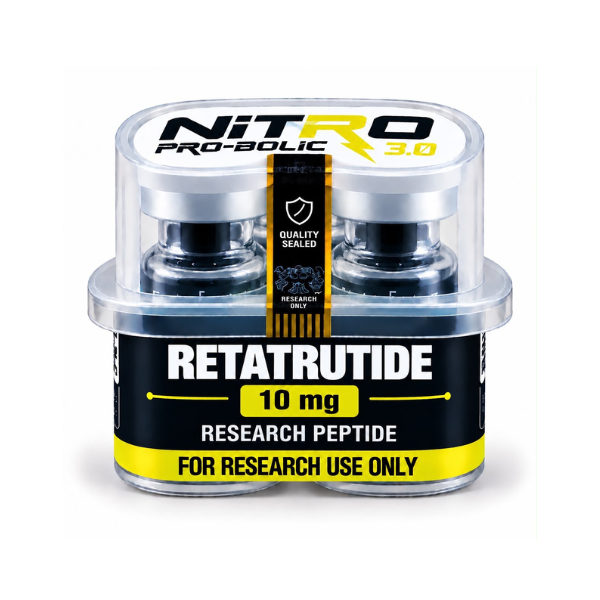
Retatrutide 10mg | Kit with 3mL Bacteriostatic Water – Nitro Probolic
$199.00
Product Name: Retatrutide 10 mg – Research Peptide Kit with 3 mL Bacteriostatic Water
Scientific Identifier: LY3437943
Active Compound: Retatrutide
Compound Classification: Investigational Triple Receptor Agonist / Research Peptide
Receptor Targets: Glucose-Dependent Insulinotropic Polypeptide (GIP), Glucagon-Like Peptide-1 (GLP-1), and Glucagon Receptors
Declared Peptide Content: 10 mg per Vial
Physical Form: Powder (Exact Physical Characteristics Not Specified)
Kit Contents:
- Vial 1: Retatrutide Powder – 10 mg
- Vial 2: Bacteriostatic Water – 3 mL
Package Presentation: 2-Vial Research Kit
Total Declared Peptide Content: 10 mg per Kit
Included Diluent: 3 mL Bacteriostatic Water (Composition and Sterility Not Independently Verified)
Research Areas: Body Weight Regulation, Glucose Metabolism, Energy Balance, and Metabolic Health
Clinical Development Status: Investigational Compound Under Clinical Evaluation
Human Therapeutic Approval: Not Established; Retatrutide Is Not an FDA-Approved Medication
Product-Specific Clinical Validation: Not Established
Intended Classification: Research Peptides
Use Restriction: For Research Purposes Only. Not Approved for Human Therapeutic Administration.
Product Verification: Roidsdeal and Finest Gears consistently identify Retatrutide 10 mg, 3 mL bacteriostatic water, and a two-vial kit. However, both descriptions are identical and do not constitute independent verification. Manufacturer identity, peptide purity, actual content, identity testing, diluent composition, sterility, and batch-specific laboratory documentation remain unverified.
Retatrutide 10 mg – Research Peptide Kit with 3 mL Bacteriostatic Water
1. Product Overview
Retatrutide 10 mg is presented as a research peptide kit containing a declared 10 mg of retatrutide powder and a separate vial of 3 mL bacteriostatic water.
According to the supplied Roidsdeal and Finest Gears descriptions, the product is packaged as a two-vial research kit.
Retatrutide, also identified by the scientific development code LY3437943, is an investigational peptide-based compound designed to activate three metabolic hormone receptors: glucose-dependent insulinotropic polypeptide (GIP), glucagon-like peptide-1 (GLP-1), and glucagon.
These receptor systems participate in glucose regulation, appetite-related signaling, energy metabolism, and other metabolic processes.
The simultaneous activity of retatrutide at these three receptors has attracted scientific interest in metabolic research.
The supplied descriptions identify body weight regulation, glucose metabolism, and metabolic health as major research areas.
Retatrutide remains an investigational compound, and its safety and efficacy are subject to clinical evaluation.
The research findings associated with the retatrutide molecule do not establish that this particular commercial research kit is equivalent to material used in clinical trials.
The supplied information does not identify the manufacturer or provide independent analytical documentation for the product.
Accordingly, its actual peptide identity, content, purity, and pharmaceutical quality have not been established.
2. What Is Retatrutide?
Retatrutide is an investigational peptide-based molecule associated with the scientific identifier LY3437943.
It is designed to activate three different hormone receptors involved in metabolic regulation.
These receptors are:
Glucose-Dependent Insulinotropic Polypeptide (GIP) Receptor
The GIP receptor participates in incretin-related metabolic signaling and glucose-dependent insulin responses.
Glucagon-Like Peptide-1 (GLP-1) Receptor
The GLP-1 receptor participates in glucose-dependent insulin secretion, appetite-related signaling, and gastrointestinal regulation.
Glucagon Receptor
The glucagon receptor participates in hepatic glucose metabolism and energy regulation.
Retatrutide is distinguished from compounds targeting only GLP-1 receptors or both GIP and GLP-1 receptors because it has been designed to activate all three receptor systems.
This pharmacological profile has generated interest in clinical research involving obesity, type 2 diabetes, and other metabolic conditions.
However, retatrutide’s investigational status means that the safety and effectiveness of the compound continue to require appropriate clinical evaluation.
The supplied product is described as a research kit rather than an authorized prescription medication.
3. How Does Retatrutide Work?
Retatrutide is designed to activate GIP, GLP-1, and glucagon receptors.
These receptor systems are involved in interconnected metabolic pathways.
GIP Receptor Activity
GIP is an incretin hormone involved in the body’s response to nutrient intake.
GIP receptor activation participates in glucose-dependent insulin secretion and related metabolic signaling.
GLP-1 Receptor Activity
GLP-1 receptor signaling is involved in glucose regulation and appetite-related physiological processes.
GLP-1 receptor agonism can influence insulin secretion, glucagon regulation, gastric emptying, and central appetite pathways.
Glucagon Receptor Activity
Glucagon receptor signaling influences hepatic glucose production and energy metabolism.
Glucagon activity is an important component of normal metabolic regulation.
Triple Receptor Agonism
Retatrutide combines activity at all three receptor systems.
Researchers are investigating whether this combined pharmacological profile produces metabolic effects that differ from those of single- or dual-receptor agonists.
However, the relative contribution of each receptor to individual clinical outcomes remains an area of scientific investigation.
Metabolic Signaling
The combined receptor activity is relevant to research involving body weight, glucose regulation, and energy balance.
These mechanisms explain the scientific interest in retatrutide but do not establish the therapeutic effectiveness of the supplied commercial research kit.
4. Research Areas & Clinical Information
Retatrutide has attracted scientific interest because of its investigational triple-receptor activity.
The supplied descriptions identify three primary research areas.
Body Weight Regulation
Clinical studies have investigated retatrutide in populations with obesity or overweight.
Researchers are examining its effects on body weight and related metabolic parameters.
However, findings from controlled clinical studies cannot be assumed to apply to unverified commercial research preparations.
Glucose Metabolism
Retatrutide is being investigated for its effects on glucose regulation and related metabolic processes.
Research includes populations with type 2 diabetes.
Its activity at incretin and glucagon receptors provides a scientific basis for these investigations.
Energy Balance
The GIP, GLP-1, and glucagon receptor systems participate in physiological pathways involved in energy regulation.
Researchers are examining the metabolic consequences of simultaneous activation of these pathways.
Metabolic Health
The supplied descriptions identify metabolic health as a broader research area.
This includes scientific interest in metabolic conditions associated with obesity and impaired glucose regulation.
Metabolic Dysfunction-Associated Steatotic Liver Disease
Retatrutide has also attracted research interest in metabolic dysfunction-associated steatotic liver disease (MASLD) and related liver-metabolic conditions.
However, investigational research does not establish an approved indication.
Clinical Safety Evaluation
Clinical studies assess potential benefits alongside adverse effects and tolerability.
The long-term safety profile and appropriate therapeutic role of investigational compounds require continuing evaluation.
Product-Specific Research Limitations
The supplied research kit has not been shown to be identical to the retatrutide formulations used in published clinical studies.
No product-specific clinical trials, pharmacokinetic studies, or independent quality assessments have been provided.
5. Product Specifications & Packaging
| Specification | Details |
|---|---|
| Product Name | Retatrutide 10 mg Research Peptide Kit |
| Scientific Identifier | LY3437943 |
| Active Compound | Retatrutide |
| Compound Classification | Investigational Triple Receptor Agonist |
| Receptor Targets | GIP, GLP-1, Glucagon |
| Declared Peptide Content | 10 mg |
| Physical Form | Powder |
| Kit Presentation | 2 Vials |
| Vial 1 | Retatrutide Powder, 10 mg |
| Vial 2 | Bacteriostatic Water, 3 mL |
| Total Declared Peptide Content | 10 mg |
| Category | Research Peptides |
| Manufacturer | Not Specified |
| Brand | Not Specified |
| Peptide Purity | Not Provided |
| Batch-Specific COA | Not Provided |
| Independent Identity Testing | Not Provided |
| Diluent Composition Verification | Not Provided |
| Sterility Testing | Not Provided |
| Product-Specific Regulatory Approval | Not Established |
| Intended Classification | Research Use Only |
Both Roidsdeal and Finest Gears identify the same product specifications.
They agree on the declared 10 mg peptide content, 3 mL bacteriostatic water quantity, and two-vial presentation.
However, the descriptions are identical.
Therefore, their agreement should not be interpreted as independent confirmation of product authenticity or laboratory quality.
The supplied information does not identify the manufacturer or provide a batch-specific certificate of analysis.
It also does not establish the exact physical characteristics of the powder, the complete diluent composition, or verified sterility.
6. Research Use & Scientific Supervision
Retatrutide is an investigational compound.
The supplied kit is categorized as a research peptide product.
The research classification does not establish suitability for human administration.
The presence of bacteriostatic water does not establish that the peptide vial is sterile, clinically appropriate, or suitable for injection.
The supplied documentation does not provide verified preparation instructions, validated stability data, or product-specific compatibility information.
No reconstitution procedure, injection method, dosage schedule, or self-administration guidance is established by the supplied sources.
Clinical investigations of retatrutide involve controlled protocols, defined eligibility criteria, and medical oversight.
A commercial research kit should not be assumed equivalent to clinical-trial material.
Research involving this compound should be conducted only within appropriate scientific, institutional, and regulatory frameworks.
7. Possible Side Effects & Safety Limitations
Retatrutide remains under clinical investigation.
Adverse effects observed or investigated in clinical studies of the retatrutide molecule may include gastrointestinal and metabolic effects.
Gastrointestinal Effects
Potential adverse effects associated with investigational incretin-based therapies include:
- Nausea
- Vomiting
- Diarrhea
- Constipation
- Abdominal discomfort
Metabolic Effects
Retatrutide affects hormone pathways involved in glucose regulation.
Changes in blood glucose and other metabolic parameters are relevant safety considerations.
Cardiovascular Considerations
Clinical research evaluates cardiovascular parameters, including heart rate and other physiological responses.
Gallbladder and Pancreatic Considerations
Gallbladder-related complications and pancreatic safety are relevant considerations in the broader evaluation of incretin-based metabolic therapies.
Hypersensitivity
Allergic or hypersensitivity reactions may occur with peptide-based pharmaceutical compounds.
Product-Specific Quality Risks
Unverified research preparations may introduce additional risks involving:
- Incorrect peptide identity
- Incorrect declared content
- Impurities or degradation products
- Microbial contamination
- Endotoxin contamination
- Unverified diluent composition
- Inadequate stability documentation
The supplied information does not establish the safety profile of this particular research kit.
8. Warnings & Precautions
Retatrutide is an investigational compound.
The supplied descriptions explicitly state that it is not approved for human therapeutic administration.
The product should not be represented as an approved treatment for obesity, diabetes, liver disease, or any other medical condition.
The presence of a separate bacteriostatic water vial does not establish clinical suitability.
The supplied documentation does not confirm peptide identity, purity, sterility, stability, or manufacturing quality.
Clinical research findings involving retatrutide should not be used to make unsupported claims about this specific commercial preparation.
The product should not be assumed interchangeable with authorized GLP-1 or GIP/GLP-1 medications.
Its investigational status and the absence of product-specific quality documentation are important limitations.
9. Storage & Handling
The supplied descriptions identify a powder vial and a separate vial containing bacteriostatic water.
However, they do not specify verified manufacturer storage temperatures, stability conditions, or expiration requirements.
Peptide stability can depend on formulation, moisture exposure, temperature, light, and packaging.
Storage conditions should follow authentic manufacturer documentation when available.
The two vials should remain in their original, clearly identified packaging.
Avoid conditions that may compromise product integrity.
The supplied information does not establish validated storage conditions after mixing or any in-use stability period.
The presence of bacteriostatic water should not be interpreted as evidence of validated preparation stability or sterility.
Keep the kit away from children and unauthorized access.
10. Frequently Asked Questions (FAQs)
What is Retatrutide?
Retatrutide, also known as LY3437943, is an investigational peptide-based molecule designed to activate GIP, GLP-1, and glucagon receptors.
How much Retatrutide is included in this kit?
Both supplied sources identify one vial containing a declared 10 mg of retatrutide powder.
Does the kit include bacteriostatic water?
Yes. The supplied descriptions identify a separate vial containing 3 mL of bacteriostatic water.
What is Retatrutide being studied for?
The supplied descriptions identify body weight regulation, glucose metabolism, and metabolic health as major research areas.
Is this Retatrutide research kit approved for human treatment?
No. The supplied descriptions explicitly state that the product is for research purposes only and is not approved for human therapeutic administration.
11. Conclusion & Medical Disclaimer
Retatrutide 10 mg is presented as a two-vial research peptide kit containing a declared 10 mg of retatrutide powder and 3 mL of bacteriostatic water.
Retatrutide, identified scientifically as LY3437943, is an investigational triple GIP, GLP-1, and glucagon receptor agonist.
Its pharmacological characteristics have generated scientific interest in body weight regulation, glucose metabolism, energy balance, and metabolic health.
Both Roidsdeal and Finest Gears provide consistent specifications for the kit.
However, their descriptions are identical and do not constitute independent product verification.
Manufacturer identity, actual peptide content, purity, sterility, diluent composition, batch-specific laboratory testing, and product stability remain unverified.
The research findings associated with the retatrutide molecule do not establish the clinical suitability of this commercial research kit.
Research & Medical Disclaimer: This product is described for research purposes only. Retatrutide is investigational and is not an FDA-approved medication. This information does not constitute medical advice, human dosing guidance, preparation instructions, or a recommendation for self-administration or treatment of any disease.
Brand
NITRO
Be the first to review “Retatrutide 10mg | Kit with 3mL Bacteriostatic Water – Nitro Probolic”
Related products
-11%

Original price was: $258.00.$229.00Current price is: $229.00.
-8%

Out of stock
Original price was: $260.00.$240.00Current price is: $240.00.
-11%

Original price was: $270.00.$239.00Current price is: $239.00.
-19%

Original price was: $318.00.$259.00Current price is: $259.00.
Reviews
There are no reviews yet.