
 USA WAREHOUS
 EUROPE WAREHOUSE
No products in the cart.
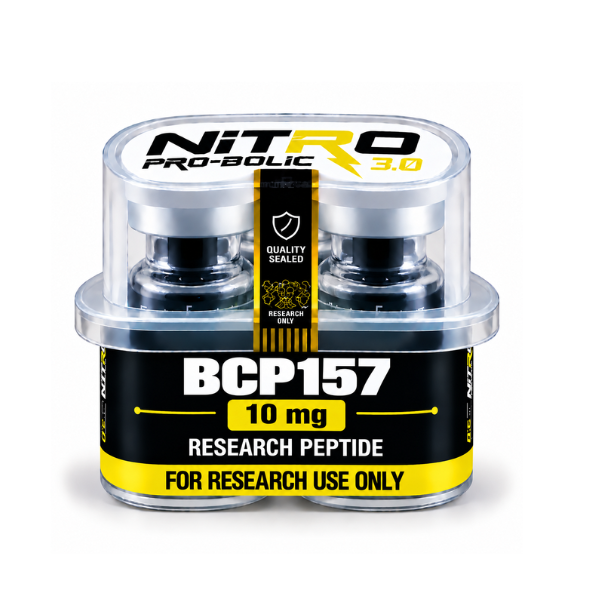
BPC-157 10mg | Kit with 3mL Bacteriostatic Water – Nitro Probolic
$149.00
Active Ingredient: BPC-157 (Body Protection Compound-157)
Manufacturer: Nitro Labs (As Listed by Roidsdeal)
Strength / Content: 10 mg BPC-157 per Vial
Product Form: Research Peptide Powder (Lyophilized Form According to Finest Gears)
Package Size: 2-Vial Kit — 1 × 10 mg BPC-157 Vial + 1 × Bacteriostatic Water Vial
Bacteriostatic Water Volume: 3 mL According to Product Title and Roidsdeal Long Description; 2 mL According to Roidsdeal Short Description
Classification: Synthetic Research Peptide / Experimental Compound
Peptide Structure: 15 Amino Acids (Pentadecapeptide)
Research Areas: Preclinical Tissue Repair, Inflammatory Signaling, Gastrointestinal Protection, and Angiogenesis
Administration Status: Research Use Only — Not Approved for Human Administration
Regulatory Status: BPC-157 is not FDA-approved for human therapeutic use. Human safety and clinical efficacy have not been adequately established.
Product Verification: The included bacteriostatic water volume, peptide identity, lyophilized form, purity, batch-specific testing, and manufacturer documentation require verification before publication.
BPC-157 10 mg – Research Peptide Kit with Bacteriostatic Water | Nitro Labs
1. Product Overview
BPC-157 10 mg is a synthetic research peptide product listed under the Nitro Labs manufacturer name. According to the supplied Roidsdeal description, the kit contains one vial of BPC-157 powder with a declared content of 10 mg and a separate vial of bacteriostatic water.
The product title and Roidsdeal long description identify the bacteriostatic water volume as 3 mL. However, the Roidsdeal short description specifies 2 mL. This discrepancy requires confirmation before the kit contents can be accurately represented.
BPC-157, also known as Body Protection Compound-157, is a synthetic peptide composed of 15 amino acids.
It has attracted scientific interest because of experimental findings involving tissue repair, cellular signaling, inflammatory responses, and gastrointestinal protection.
Most published research has been conducted using laboratory and animal models.
Although these findings have generated scientific interest, they do not establish that BPC-157 is safe or effective for treating injuries or medical conditions in humans.
BPC-157 is not approved by the U.S. Food and Drug Administration (FDA) for human therapeutic use.
The product is described for research purposes only and should not be represented as an approved medication, supplement, or self-administered treatment.
2. What Is BPC-157?
BPC-157 is a synthetic pentadecapeptide consisting of 15 amino acids.
It is associated with research involving a peptide sequence originally described in connection with gastric protective factors.
Its scientific name, Body Protection Compound-157, reflects its research history rather than an established therapeutic indication.
BPC-157 is not an anabolic-androgenic steroid, testosterone derivative, or approved human growth hormone product.
Unlike anabolic steroids, it is studied primarily in relation to cellular signaling, tissue responses, and experimental repair mechanisms.
Researchers have investigated BPC-157 in several preclinical settings, including:
- Tendon and ligament injury models
- Skeletal muscle injury models
- Gastrointestinal mucosal injury models
- Inflammatory signaling studies
- Blood vessel formation and tissue vascularization
- Experimental cellular repair pathways
These investigations are primarily exploratory.
Results observed in animal models cannot be assumed to occur in humans under comparable conditions.
The exact clinical pharmacology, effective exposure range, long-term safety profile, and therapeutic value of BPC-157 in humans remain insufficiently established.
3. How Does BPC-157 Work?
The biological mechanisms associated with BPC-157 are still under investigation.
Preclinical research has explored its possible involvement in cellular pathways associated with tissue repair, inflammatory regulation, and vascular responses.
Cellular Signaling
Experimental studies have examined whether BPC-157 influences signaling processes involved in cellular survival, migration, and responses to tissue injury.
These observations are not sufficient to establish a clinically validated mechanism of action in humans.
Fibroblast Activity
Fibroblasts are connective tissue cells involved in the production and organization of extracellular matrix components.
Some preclinical investigations have examined BPC-157 in relation to fibroblast activity and connective tissue repair processes.
Angiogenesis
Angiogenesis refers to the formation of new blood vessels from existing vascular structures.
Certain experimental studies have investigated the relationship between BPC-157 and pathways associated with vascular development.
These findings remain preliminary and do not establish predictable or beneficial effects in human patients.
Inflammatory Responses
BPC-157 has also been investigated in experimental models involving inflammatory signaling and tissue injury.
However, the available evidence does not establish that BPC-157 is an effective anti-inflammatory medication for humans.
Its complete pharmacokinetic profile, metabolism, and long-term biological effects remain inadequately characterized.
4. Medical Uses & Clinical Information
BPC-157 is an experimental research compound without established FDA-approved human therapeutic indications.
Scientific investigations have explored several potential research applications.
Muscle and Tendon Research
Animal studies have examined BPC-157 in experimental models involving muscle, tendon, and ligament injuries.
Researchers have investigated tissue organization, cellular responses, and other markers associated with injury recovery.
These findings do not establish that BPC-157 accelerates healing or improves recovery in humans.
Gastrointestinal Research
BPC-157 has been investigated in preclinical models of gastrointestinal mucosal injury.
Research has explored its potential relationship with protective and repair-related mechanisms in gastrointestinal tissues.
However, BPC-157 is not an FDA-approved treatment for ulcers, inflammatory bowel disease, or other gastrointestinal disorders.
Inflammatory Signaling Research
Experimental studies have examined BPC-157 in relation to inflammatory pathways and tissue responses.
The clinical significance of these observations remains uncertain.
Vascular and Regeneration Research
Some preclinical studies have explored angiogenesis and other processes associated with tissue regeneration.
These investigations do not establish an approved regenerative medicine application.
Human Clinical Evidence
Human safety and efficacy data remain limited and insufficient to support routine clinical use.
The absence of comprehensive clinical trials means that appropriate therapeutic indications, safe dosing ranges, adverse-effect frequencies, and long-term outcomes have not been established.
BPC-157 should not be described as a clinically proven treatment for muscle injuries, tendon damage, gastrointestinal disease, or postoperative recovery.
5. Product Specifications & Packaging
| Specification | Details |
|---|---|
| Product Name | BPC-157 10 mg Research Peptide Kit |
| Listed Manufacturer | Nitro Labs |
| Active Compound | BPC-157 |
| Alternative Name | Body Protection Compound-157 |
| Compound Type | Synthetic Pentadecapeptide |
| Amino Acid Length | 15 Amino Acids |
| Declared Peptide Content | 10 mg per Vial |
| Product Form | Powder; Lyophilized According to Finest Gears |
| Package Presentation | 2-Vial Kit |
| Vial 1 | BPC-157 Powder, 10 mg |
| Vial 2 | Bacteriostatic Water |
| Water Volume | 3 mL or 2 mL — Source Conflict |
| Product Category | Research Peptides |
| Active Half-Life | Not Well Established |
| FDA-Approved Human Use | None |
| Human Administration Status | Not Approved |
| Batch-Specific Testing | Documentation Claimed; Not Independently Verified |
| Purity and Sterility | Not Independently Verified |
The supplied sources consistently identify BPC-157 as the active compound with a declared content of 10 mg.
However, the exact bacteriostatic water volume requires confirmation.
The Roidsdeal description states that technical documentation and laboratory analysis reports may be available upon request.
These statements do not independently establish that the specific product or batch has passed validated identity, purity, sterility, or quality testing.
6. Research Use & Scientific Supervision
BPC-157 is described as a research peptide.
Its inclusion in a kit with bacteriostatic water does not establish that the product is approved or suitable for human administration.
No FDA-approved human dosing regimen, administration route, or treatment duration has been established for BPC-157.
The supplied Finest Gears description includes quantity references based on the amount of peptide contained in individual vials.
These references describe quantities but do not establish medically appropriate dosing instructions.
BPC-157 should not be treated as an approved medication for self-injection, injury recovery, gastrointestinal treatment, or athletic performance enhancement.
Research involving experimental peptides requires appropriate scientific oversight, documented material identity, and compliance with applicable laboratory and regulatory requirements.
The exact peptide purity, formulation characteristics, stability, and batch-specific quality documentation should be verified before any scientific interpretation of product-related results.
7. Possible Side Effects & Safety Limitations
The safety profile of BPC-157 in humans has not been adequately established.
Because robust human clinical studies are lacking, the frequency, severity, and long-term consequences of potential adverse effects remain uncertain.
Important safety uncertainties include:
- Unknown long-term systemic effects
- Incompletely characterized immune responses
- Potential hypersensitivity reactions
- Uncertain effects on inflammatory signaling
- Uncertain effects on vascular signaling
- Limited information about reproductive and developmental safety
- Unknown interactions with medications and other experimental compounds
- Possible risks associated with product contamination or impurities
Some online product descriptions suggest that BPC-157 has a low incidence of adverse effects.
Such claims should not be treated as established clinical safety findings.
The Finest Gears short description lists acne as possible and water retention as low.
However, the supplied materials do not provide human clinical evidence establishing these effects or their frequency.
Similarly, the absence of aromatization is not a meaningful substitute for a complete peptide safety assessment.
Experimental findings involving tissue regeneration and angiogenesis also require careful evaluation because biological signaling pathways can have complex effects.
The available evidence is insufficient to establish the safety of repeated or long-term human exposure.
8. Warnings & Precautions
BPC-157 is not FDA-approved for human therapeutic use.
It should not be marketed as an established treatment for tendon injuries, ligament damage, muscle recovery, gastrointestinal disease, or inflammatory conditions.
Claims of accelerated healing or tissue regeneration must be clearly distinguished from preliminary laboratory findings.
Individuals should not substitute experimental peptides for evidence-based medical assessment or treatment.
The safety of BPC-157 during pregnancy, breastfeeding, childhood, and adolescence has not been adequately established.
Potential interactions with prescription medications and other experimental compounds are also insufficiently characterized.
The presence of bacteriostatic water in a product kit does not establish sterility, pharmaceutical authorization, or suitability for injection.
Claims regarding purity, batch testing, and quality assurance should be supported by authentic, product-specific documentation.
BPC-157 is also prohibited under the World Anti-Doping Agency’s rules for non-approved substances.
Research-only labeling does not eliminate applicable regulatory requirements or establish product quality.
9. Storage & Handling
BPC-157 is described as a powdered research peptide supplied in a separate vial from bacteriostatic water.
However, the supplied descriptions do not establish verified manufacturer storage temperatures, stability data, or expiration conditions.
Lyophilized research peptides may have material-specific storage requirements that depend on formulation, packaging, and stability characteristics.
These requirements should be confirmed through authentic manufacturer documentation.
The bacteriostatic water should also have its own verified labeling, composition, expiration information, and storage instructions.
The supplied sources do not establish validated compatibility or stability after combining the peptide with the included liquid.
No product-specific reconstitution or post-reconstitution storage instructions can be confirmed from the supplied information.
Keep research materials in their original, clearly identified packaging and away from children and pets.
Materials with uncertain identity, compromised packaging, or unverified storage history should not be assumed suitable for laboratory or human use.
10. Frequently Asked Questions (FAQs)
What is BPC-157?
BPC-157 is a synthetic peptide consisting of 15 amino acids. It has been investigated in preclinical studies involving tissue repair, inflammatory signaling, and gastrointestinal protection.
How much BPC-157 is included in the kit?
The supplied descriptions identify one vial containing 10 mg of BPC-157.
How much bacteriostatic water is included?
The product title and Roidsdeal long description specify 3 mL, while the Roidsdeal short description specifies 2 mL. The correct volume requires manufacturer verification.
Is BPC-157 FDA-approved for human use?
No. BPC-157 is not FDA-approved for human therapeutic use, and its clinical efficacy and safety have not been adequately established.
Does research on BPC-157 prove that it heals injuries in humans?
No. Most available findings come from laboratory and animal studies. These results do not establish clinically proven healing benefits in humans.
11. Conclusion & Medical Disclaimer
BPC-157 10 mg is presented as a synthetic research peptide kit containing one vial of BPC-157 powder and a separate vial of bacteriostatic water.
The compound has attracted scientific interest because of preclinical findings involving tissue repair, inflammatory signaling, gastrointestinal protection, and vascular responses.
However, these findings do not establish proven therapeutic benefits or adequate safety in humans.
The exact water volume, product authenticity, purity, sterility, and batch-specific laboratory documentation require verification.
For research purposes only. Not intended for human self-administration or for the diagnosis, treatment, prevention, or cure of any disease.
This information is provided for educational and scientific product-identification purposes only and does not constitute medical advice.
Brand
NITRO
Be the first to review “BPC-157 10mg | Kit with 3mL Bacteriostatic Water – Nitro Probolic”
Related products
Out of stock
-8%

Out of stock
Original price was: $260.00.$240.00Current price is: $240.00.
-19%

Out of stock
Original price was: $270.00.$220.00Current price is: $220.00.

Out of stock
Reviews
There are no reviews yet.